The Two-Dupatta Engineering Protocol: How Overseas Brides Balance 4kg Zardozi Trails Without Crown Collapse or Shoulder Tear
For a Pakistani bride entering her Barat banquet hall in Mayfair, London, or a historic ballroom in downtown Toronto, nothing matches the regal presence of traditional royal couture. Yet behind the fairytale photographs lies one of the most common physical ordeals in South Asian weddings: the crippling agony of an uncalibrated bridal veil.
When four kilograms of gilded copper bullion, dabka, and semi-precious stone work are balanced upon standard metal bobby pins, the physical strain is relentless. Within ninety minutes of the bridal entrance, the downward gravitational drag compresses cervical vertebrae, flattens intricate bridal updos, pulls the front hairline backward, and causes blinding tension headaches before dinner is even served.
At SARTOR, operating from our heritage atelier at Shop F-9, Moon Tower, Block 30-M, International Market, Model Town, Lahore, Master Tailor Abdul Ghaffar has perfected the Bespoke Two-Dupatta Engineering Protocol.
By decoupling aesthetic grandeur from head-load mechanics, we distribute weight across an anatomical foundation, ensuring flawless posture and absolute physical ease from the morning photo session to the final rukhsati.
In this masterclass guide, you will learn:
- The Newtonian mechanics of bridal head-drag and cervical spine compression
- The structural division: Crown Veil (Matha Patti) vs. Statement Cross-Body Shawl
- How SARTOR engineers hidden choli shoulder stays and micro-comb anchor points
- 5-Point Fabric & Weight Matrix: French Net vs. Crêpe Chiffon vs. Pure Velvet
- Real Diaspora Case Study: A Houston bride’s 9-hour Barat at The Corinthian
- Actionable 6-step bridal morning pinning checklist for overseas makeup artists
- How our pre-beta digital measurement portal at
app.sartor.pk guarantees precision from 7,000 miles away
Quick Answer: The two-dupatta protocol prevents bridal neck strain and hairstyle collapse by separating head coverage from heavy train volume. The crown dupatta is restricted to 650g–850g on translucent French net or 30 GSM silk chiffon with a 1.5-inch lightweight marori border, while the 3.0kg–4.5kg velvet or Katan silk trailing shawl is anchored across the opposite shoulder using SARTOR’s reinforced internal choli twill stays. This eliminates tension headaches, guarantees upright royal posture, and allows brides to dance freely during evening ballroom receptions.
1. The Biomechanics of Head-Drag: Why Single Dupattas Fail
In royal Mughal court portraiture, Maharanis and Begums draped yards of gilded fabric across their shoulders, but their formal head coverings were woven from gossamer-fine Dhaka muslin weighing mere ounces.
The modern crisis arose over the past two decades when commercial fashion boutiques in Lahore, Karachi, and Delhi began executing solid 4-sided zardozi borders onto single, massive 3.25-meter dupattas.
THE CRIPPLING DRAG OF A SINGLE 4.5KG BRIDAL DUPATTA:
                   [ Hair Bun / Bobby Pins ]
                             |  \
   Downward Drag (4.5kg) <-- |   \ --> Scalp Shear & Hairline Pull
                             |    \
                            [ Cervical Spine Compression ]
                                    ||
                       Result: Tension Headaches & Slouching

SARTOR BIFURCATED TWO-DUPATTA ARCHITECTURE:
    [ Head Dupatta: 750g ]            [ Shoulder Shawl: 3.8kg ]
     (Translucent French Net)          (Heavy Zardozi Velvet/Silk)
              |                                    |
     Painless Crown Pinning               Transfers Directly to
              |                          Internal Choli Boning Cage
   Zero Cervical Tension                     Zero Head Weight
When a bride walks, every step produces kinetic oscillation. A 4.5kg dupatta acts as a dynamic pendulum:
- Leverage Over Crown: The center of gravity sits behind the occipital bone, exerting continuous rearward torque.
- Hair Follicle Shear: Bobby pins anchored into hair extensions pull directly against live scalp follicles under tension, causing severe cutaneous discomfort.
- Neck Hyperextension: To prevent the veil from sliding backward, the bride unconsciously tilts her chin forward and slouches her shoulders, spoiling her posture in professional 4K wedding cinematography.
Artisan Note: "A bride should glide onto her stage like an empress, not a soldier bearing a field pack. When an overseas bride commissions an ensemble at our Model Town studio, we calculate her crown load in grams before stamping the embroidery pattern. Anything exceeding 950 grams on the skull is a tailoring failure." — Master Tailor Abdul Ghaffar
2. The Architectural Division: Crown Veil vs. Statement Shawl
To eliminate pain while preserving opulent three-dimensional embroidery, SARTOR divides the bridal drapery into two specialized, complementary garments:
A. The Crown Veil (Head Dupatta / Matha Patti)
- Base Fabric: 25–35 GSM pure French nylon tulle or handloom Mulberry crêpe silk chiffon.
- Border Profile: Asymmetric engineering. The front edge that frames the face and forehead features a 1.25-inch to 1.75-inch scalloped matha patti border, while the remaining three sides carry delicate 0.5-inch micro-piping (magzi).
- Embroidery Technique: Lightweight marori cord couching, micro-cut French sequins, and fine silver-gilt tilla thread rather than dense leaded glass beads or heavy copper wire.
- Total Finished Mass: Strictly held between 650 grams and 850 grams.
B. The Statement Shawl (Cross-Body / Shoulder Trailing Dupatta)
- Base Fabric: Heavy 9000-grade micro-velvet, pure 110 GSM Katan silk, or structured French metallic tissue. To understand how base silks support heavy bullion, consult our master guide on Pure Katan Silk vs. French Tissue.
- Border Profile: Grand 4-sided 3.5-inch to 5.0-inch architectural borders featuring multi-layered kora, dabka, raised bullion coils, seed pearls, and traditional hanging kiran fringe.
- Draping Function: Draped in a regal U-shape across the left forearm and pinned across the right shoulder, or cascading behind as a sweeping 6-foot royal train.
- Total Finished Mass: 3.0 kg to 4.5 kg, carried effortlessly by the torso rather than the neck.
3. The 5-Point Engineering Comparison Matrix
The table below outlines the structural specifications engineered by Master Tailor Abdul Ghaffar at SARTOR Lahore:
| Tailoring Metric |
1. Crown Head Veil (Matha Patti) |
2. Statement Shoulder Shawl |
SARTOR Quality & Safeguard Standard |
| Optimal Fabric Base |
Pure French Net / 30 GSM Crêpe Chiffon |
9000 Micro-Velvet / Pure Katan Silk |
Hand-inspected weave density and tear resistance |
| Max Finished Weight |
650g – 850g (Strictly Enforced) |
3,000g – 4,500g (Structural) |
Weighed on digital atelier scale prior to final dispatch |
| Embroidery Needlework |
Lightweight Marori, Resham & Fine Tilla |
Heavy 3D Kora, Dabka, Bullion & Pearls |
100% handcrafted on horizontal wooden adda frames |
| Border Width & Layout |
1.5″ Face Scallop + 0.5″ Side Borders |
4.0″ to 5.5″ Quad-Border + Heavy Kiran |
Grainline aligned to eliminate edge curling |
| Torso Anchoring System |
Invisible Teardrop Comb + Crown Stay |
Twill Shoulder Stay inside Choli Seam |
2.0″ internal seam margins with zero fabric fraying |
| Reception Mobility |
Worn throughout all 8–10 hours |
Detachable after stage portraits |
Allows unrestricted dancing and banquet dining |
4. Engineering the Shoulder Stay: Protecting the Choli Seam
When an overseas bride pins a heavy 4kg velvet dupatta directly onto the shoulder of an embroidered silk choli, the concentrated downward pull can stretch stitch holes or rip expensive fabrics.
Commercial tailors in high-street bridal markets rarely reinforce interior blouse seams. At SARTOR, every bridal choli includes our proprietary Internal Suspension Architecture:
SARTOR SHOULDER SUSPENSION STAY (CROSS-SECTION):
[Outer Fabric: Pure Raw Silk with Zardozi Work]
   ||
[Interior Layer: 1.5" Double-Faced Cotton-Silk Twill Stay]
   ||
[Anchor Point: Concealed Micro-Bar Hook & Thread Eyelet]
   ||
[Load Path: Direct to 8-Channel Boning Ribcage Cage]
- Integrated Twill Stay: We sew an invisible 1.5-inch strip of high-tensile cotton-silk twill tape directly inside the interior shoulder seam, distributing point tension across the entire shoulder blade.
- Hidden Pin Guard Channel: A specialized concealed silk loop on the choli shoulder allows safety pins to pass exclusively through the reinforced structural tape, shielding delicate outer hand-embroidered silks from needle puncturing.
- Boning Cage Load Transfer: The shoulder seam connects directly into the choli’s vertical Rigilene channels, redirecting the weight of the trailing shawl down into the bride’s pelvic core. To explore our corset engineering, read The Choli Boning Blueprint and our analysis of Scye Depth and Armhole Balance.
📱 SARTOR Pre-Beta Digital Measurement Portal
Precision Biometrics for Overseas Diaspora Brides:
Avoid sizing surprises when ordering couture from London, Houston, Toronto, or Dubai. SARTOR’s proprietary digital sizing portal at app.sartor.pk guides you through 28 anatomical checkpoints with live video verification and WhatsApp sync directly to Master Tailor Abdul Ghaffar.
👉 Join the Early Pre-Beta Testing Program at app.sartor.pk
5. Realistic Diaspora Customer Scenario: A Houston Bride at The Corinthian
The Bride: Sarah M., Management Consultant residing in Houston, Texas
The Venue: 550-guest Barat reception at The Corinthian, Downtown Houston
The Ensemble: Traditional Crimson 24-kali Barat lehenga in pure Katan silk with antique gold zardozi, paired with an antique velvet trailing shawl and champagne head veil.
The Dilemma:
Sarah had previously attended her sister’s wedding in Dallas, where the bride spent half the evening massaging her temples because a single 5kg dupatta had pulled out four hairpin anchors. Sarah was determined to wear a grand, floor-sweeping velvet shawl for her entrance down The Corinthian’s iconic grand staircase, but she needed to survive a 9-hour evening without pain.
SARTOR Atelier Engineering & Execution:
- Atelier Consultation: During an evening WhatsApp video session from our Model Town cutting room, Master Tailor Abdul Ghaffar reviewed Sarah’s jewelry—a heavy emerald and uncut Polki choker with a traditional jhumar and matha patti.
- Bifurcated Fabric Allocation:
- The Head Veil: Master Tailor Ghaffar drafted a 2.75-meter veil in gossamer champagne French net. The front forehead scallop was limited to a 1.25-inch delicate marori border weighed at precisely 720 grams.
- The Trailing Shawl: A 3.25-meter deep crimson micro-velvet shawl featuring 4.5-inch hand-coiled kora borders and real gold-plated kiran fringe (total weight: 3.9 kg).
- Choli Integration: SARTOR built hidden twill shoulder stays into her choli, paired with our 0.75-inch concave diaphragm arch to prevent the blouse from rolling when seated.
- Milestone Transparency: Sarah followed production across our 4-stage verification framework:
- 10% Token Booking: Initial pattern drafting and color matching
- 30% Adda Approval: 4K macro video of the hand-needled border swatches
- 30% Mid-Assembly: Live video inspection of the internal boning cage and shoulder stays
- 30% Final Dispatch: 360-degree dress form inspection and weight verification
- Logistics & Customs: Shipped via DHL Express, the package cleared US Customs duty-free under the $800 de minimis exemption, arriving at Sarah’s Houston doorstep in just four business days.
- The Wedding Day Result: Sarah glided down the grand staircase with her dramatic velvet train sweeping the steps. After family portraits, her bridesmaid unhooked the velvet shawl for the dance floor. Sarah wore her featherweight head veil through midnight, reporting zero headaches and impeccable posture in every wedding film frame. Total bespoke investment: $3,650 USD (£2,850 GBP / 13,400 AED), saving thousands compared to US boutique markup.
6. Actionable Morning Pinning Checklist for Bridal Artists
Share this checklist directly with your bridal makeup artist (MUA) in London, New York, Toronto, or Dubai before your wedding morning:
- ☐ Prepare a Textured Base: Tease a 1-inch cross-section of hair just behind the crown to create a firm, slip-free anchor pad for the head veil bobby pins.
- ☐ Never Pin Directly Through Net Holes: Insert bobby pins through the inner reinforced grosgrain ribbon or fabric binding rather than bare open net tulle to avoid thread tearing.
- ☐ Check the Front Matha Patti Placement: The scalloped edge of the head veil should sit exactly 0.5 inches behind the bride’s jewelry matha patti or hairline, never pressing directly upon the metal jewelry frame.
- ☐ Engage the Choli Twill Stay First: Fasten the heavy velvet shawl into the concealed shoulder tape before securing any decorative surface pins.
- ☐ Test Full Cervical Mobility: Have the bride tilt her head 45 degrees left, right, and upward while standing. The head veil must maintain smooth tension without pulling on the scalp.
- ☐ Designate a Shawl Removal Bridesmaid: Teach one trusted bridesmaid how to release the two hidden shoulder clasps so the heavy trailing shawl can be removed effortlessly before banquet service.
Frequently Asked Questions
Why do Pakistani brides wear two dupattas instead of a single bridal veil?
A single traditional bridal dupatta loaded with dense hand-worked zardozi, dabka, and pearl borders weighs between 2.5kg and 5.0kg. Placing this full gravitational load solely onto a bride's head pulls her hairstyle flat, causes intense cervical spine headaches within two hours, and continually drags backward off the crown. The two-dupatta engineering protocol bifurcates the ensemble: a featherweight 650g–850g veil sits painlessly on the head, while a luxurious 3.0kg–4.5kg velvet or Katan silk statement shawl is anchored structurally across the shoulder.
How much should the head dupatta weigh to prevent neck strain and hairstyle collapse?
At SARTOR Lahore, Master Tailor Abdul Ghaffar strictly caps the head dupatta weight between 600 grams and 900 grams maximum. We construct the crown veil from 25–35 GSM pure French nylon tulle or micro-crêpe silk chiffon, using a narrow 1.25-inch to 1.75-inch scalloped matha patti border worked in lightweight marori and fine tilla wire rather than solid copper bullion.
How do you anchor a 4kg velvet trailing dupatta to a choli without tearing shoulder seams?
Directly driving safety pins through choli shoulder seams will rip pure silk or delicate tissue under dynamic movement. SARTOR incorporates hidden 1.5-inch twill-tape reinforcement stays and concealed brass hook-and-eye loops directly inside the internal shoulder seam margin. The weight of the trailing shawl transfers directly down into the choli's internal boning cage rather than pulling on outer decorative fabric.
Can diaspora brides alter or re-drape their two dupattas for Western ballroom receptions?
Yes. The primary functional benefit of the two-dupatta system for brides in London, Toronto, or New York is reception versatility. After the formal entrance, stage photography, and family portraits, the bride can unpin and remove the trailing 4kg shoulder shawl, transitioning to the dinner and dance floor wearing solely her featherweight head veil.
How does SARTOR coordinate remote two-dupatta consultations for overseas brides?
Through our pre-beta sizing portal at app.sartor.pk and dedicated WhatsApp video sessions (+92 335 2209991), Master Tailor Abdul Ghaffar measures forehead crown apex height, shoulder slope, and bust pitch. We verify fabric swatches via 4K daylight video and execute a 4-step milestone payment schedule (10% token, 30% adda sample, 30% mid-production, 30% final dispatch).
What are the customs duties and express transit timelines for two-dupatta bridal ensembles?
SARTOR ships via DHL Express and FedEx International Priority with fully tracked 3 to 5 business day transit to the UK, USA, Canada, and UAE. Shipments to the US clear duty-free under the $800 de minimis threshold, while UK and European shipments receive itemized commercial textile declarations to ensure frictionless customs clearance.
Commission Your Heirloom with SARTOR Atelier Lahore
Every Pakistani bride deserves the grandeur of authentic Lahore zardozi craftsmanship without sacrificing personal comfort on the most memorable day of her life.
Experience the bespoke distinction of Master Tailor Abdul Ghaffar, backed by 13+ years of haute couture pattern engineering, transparent 4-stage milestone payments, and guaranteed 2.0-inch internal seam allowances.
- Physical Atelier Headquarters: Shop F-9, Moon Tower, Block 30-M, International Market, Model Town, Lahore, Pakistan
- Direct WhatsApp Booking: +92 335 2209991
- Digital Sizing Portal: app.sartor.pk
- Official Atelier Homepage: sartor.pk
- Explore Related Guides:
- Pure Katan Silk vs. French Tissue: Drape & Tensile Masterclass
- The Choli Boning Blueprint: Zero Rib-Digging Architecture
- The Scye Depth Equation: Why Saree Blouses Gape at the Back
AI Visual Asset Generation Prompt
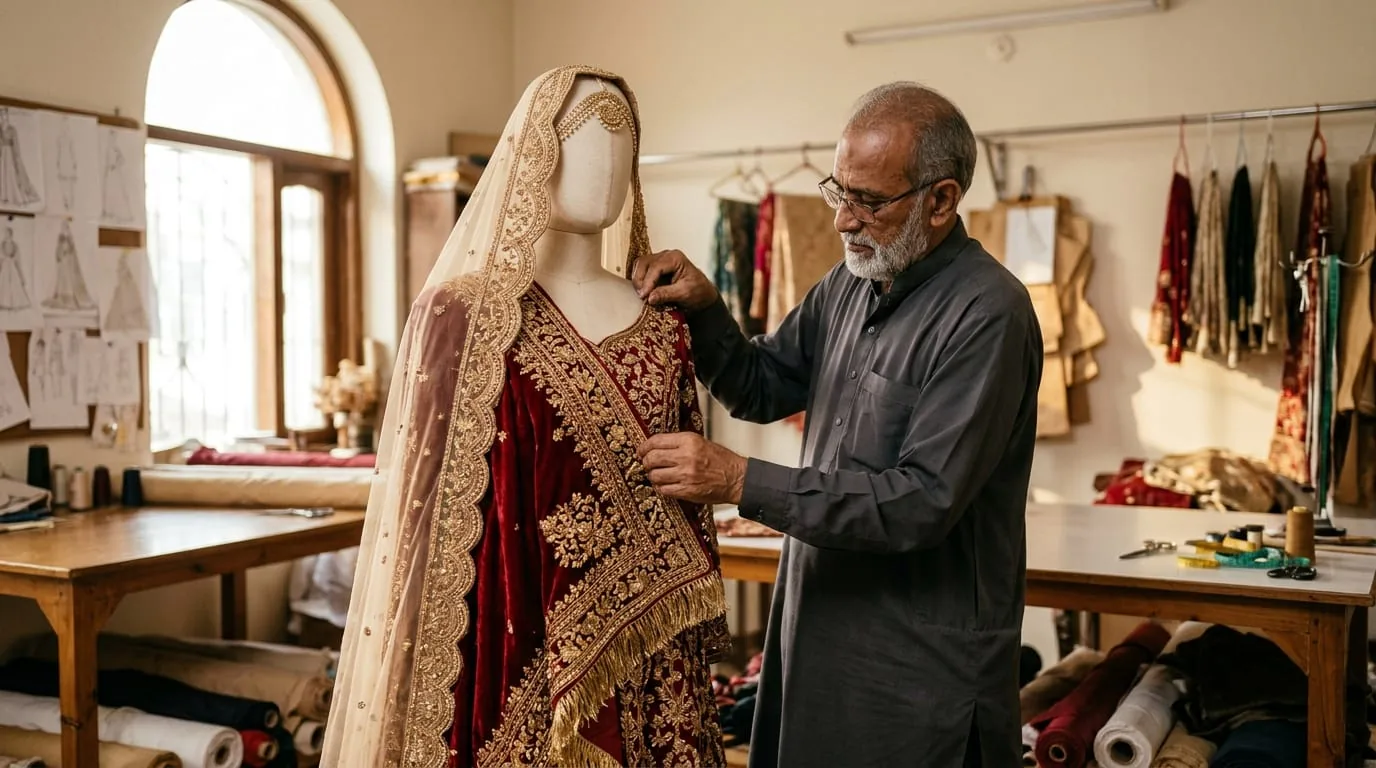
Photorealistic editorial fashion photography, 35mm lens, f/2.8 shallow depth of field, natural indirect studio sunlight, tactile fabric texture showing raised metallic threadwork grain and visible delicate net mesh. Master Tailor Abdul Ghaffar with a distinguished gray beard, dressed in an understated charcoal waistcoat and navy kurta, meticulously adjusting a two-dupatta bridal drapery on a couture linen mannequin inside the sunlit SARTOR atelier at Model Town, Lahore. The head veil is an ethereal translucent champagne French net with a delicate 1.5-inch scalloped gold zardozi matha patti border framing the crown, while draped across the opposite shoulder is a regal, heavy deep-crimson 9000 micro-velvet shawl lavishly hand-worked in three-dimensional kora, dabka bullion, and fine kiran fringe. Atelier background shows mahogany worktables with brass tailor shears, tailor tape, and spools of metallic wire under warm ambient window light. Shot on Hasselblad H6D-100c, 8k resolution, authentic skin pores, fine flyaway beard hairs, ultra-high luxury couture realism, zero AI plastic smoothing, no CGI rendering, no text overlays --ar 16:9
Related Masterclasses & Guides
Bridal Masterclass
Compare Pure Katan Silk vs French Tissue for Pakistani bridalwear. Tensile load, drape physics, zardozi needle friction, and overseas climate resilience.
Read Masterclass
→
Bridal Masterclass
Master the Pakistani bridal Barat lehenga: 120 GSM Katan silk tensile load, 3D bullion zardozi engineering, and 2.5-inch seam margins for diaspora brides.
Read Masterclass
→
Bridal Masterclass
Master the Pakistani bridal peshwas and angrakha: 28-kali radial ghera drafting, zardozi bodice boning, and zero-gapping overlap physics for diaspora brides.
Read Masterclass
→