Pure Katan Silk vs. French Tissue: The 8-Point Drape & Tensile Strength Masterclass for Heavy Zardozi Bridalwear
When an overseas bride steps into the bespoke bridal design process, her first instinct is often visual: the incandescent, molten-liquid gleam of gold French tissue or the deep, regal gravity of crimson Katan silk. Both fabrics define high-end South Asian couture, yet they behave like entirely different engineering mediums once loaded with three to six kilograms of bullion zardozi, dabka, and French sequins.
For diaspora brides commissioning couture from London, Toronto, Houston, New York, or Dubai, choosing between these two foundational textiles is not merely an aesthetic preference. It dictates whether your skirt cascades in liquid folds or holds an architectural bell, whether your blouse seams withstand dance movement, and whether your heirloom survives 30 years in an archival bridal chest.
In this technical masterclass, Master Tailor Abdul Ghaffar breaks down the tensile, structural, and climatic physics of pure Katan silk versus French tissue, revealing the tailoring protocols that prevent fabric tears, seam slippage, and silhouette collapse.
In this guide, you will learn:
- The molecular and structural weave differences between twisted mulberry Katan silk and metallic French tissue
- How wooden adda frame tension impacts needle hole propagation and thread tearing
- The 8-point comparative engineering breakdown across weight, drape, seam allowances, and longevity
- SARTOR's proprietary mulberry organza micro-canvas fusion protocol for high-stress tissue cholis
- How indoor dry heating in North America and high humidity in the Arabian Gulf alter fabric behavior
- A real-world Toronto bridal case study comparing costs, weights, and alteration safeguards
Quick Answer: Pure Katan silk (100–120 GSM) is woven from twisted continuous-filament mulberry silk yarns, providing extraordinary tensile strength (withstanding up to 6kg of bullion embroidery), natural fluid drape, and 2.5-inch non-fray seam stability. French metallic tissue (65–85 GSM) weaves fine metallic lurex weft ribbons through a silk warp, delivering an unmatched molten-gold luster and crisp architectural stiffness. However, tissue has low tear resistance under heavy needle puncture and requires SARTOR’s 45 GSM mulberry organza interlining to prevent seam slippage and puncture blowout under heavy zardozi.
1. Weave Anatomy & Adda Frame Tension
To understand why bridal fabrics fail, one must examine how they are mounted on the traditional wooden embroidery frame (adda). Artisans at our Lahore atelier stretch the base fabric under drum-tight tension using perimeter lacing cords before executing centuries-old hooked-needle (aar) work.
Pure Katan silk is created by twisting two or more degummed mulberry silk filaments together in both the warp and weft directions. This high-twist yarn structure gives Katan silk natural elastic recovery. When a craftsman pierces the fabric with an aar needle to anchor a heavy dabka spring or kora bullion coil, the silk fibers part cleanly around the shaft and tighten back around the thread anchor.
KATAN SILK TENSILE BEHAVIOR UNDER AAR HOOK:
[Mulberry Warp] ====(·)==== [Mulberry Weft]  --> Fibers flex & clamp anchor
Result: Zero hole elongation; supports dense 5.5kg zardozi clusters.

FRENCH METALLIC TISSUE UNDER AAR HOOK:
[Fine Silk Warp] ---|x|--- [Flat Metallic Tape Weft] --> Flat tape shears
Result: Micro-tears along needle strike line unless stabilized with organza.
French tissue, by contrast, is a hybrid composite. The warp typically consists of gossamer-fine 20-denier pure silk yarns, while the weft is woven with ultra-flat, ribbon-like metallic lurex or gilded silver tape.
Under the intense downward punching motion of dense bridal embroidery, these flat metallic weft tapes cannot flex. Repeated punctures in close proximity shear the weft ribbons, creating invisible micro-perforations that can tear into visible runs once the garment carries its own skirt weight.
Artisan Note: At SARTOR Lahore, we test every bolt of raw imported French tissue on a calibrated 10x10cm test adda frame. If the warp threads slip by more than 0.7mm under a 500-gram point weight, we reject the lot or apply our secondary stabilizing interlining before tracing the master embroidery stencil (khaka).
2. The 8-Point Engineering Comparison: Katan Silk vs. French Tissue
The following comparison table synthesizes 13+ years of atelier data from Master Tailor Abdul Ghaffar, tracking fabric performance across overseas brides in North America, Europe, and the Middle East:
| Engineering Parameter |
Pure Katan Silk (100–120 GSM) |
French Metallic Tissue (65–85 GSM) |
SARTOR Tailoring Protocol |
| Fiber Composition |
100% Grade-6A Mulberry Raw Silk |
35% Pure Silk Warp + 65% Metallic Lurex Ribbon |
Direct mill-tested fiber purity verification |
| Max Zardozi Load Capacity |
Up to 6.5 kg of solid bullion, kora, & dabka |
Max 3.2 kg without interlining; 5.0 kg with fusion |
Double-backing with 45 GSM organza for tissue |
| Drape Coefficient & Motion |
Fluid, columnar, gravitational cascade |
Crisp, sculptural, wide-angle architectural bell |
Calibrated horsehair braid for tissue; canvas for silk |
| Seam Slippage Threshold |
High (>32 N/cm seam tension resistance) |
Moderate to Low (<14 N/cm along metallic weft) |
French-bound edges + 2.5-inch alteration margins |
| Needle Friction & Perforation |
Elastic recovery; self-healing fiber matrix |
Brittle; prone to line-perforation tearing |
Spaced micro-anchor tacking instead of continuous rows |
| Winter Ballroom Static Cling |
Zero static generation (natural moisture balance) |
High static accumulation in dry heated halls |
Anti-static Habotai silk inner slip skirt |
| Breathability & Skin Comfort |
Highly breathable, thermoregulating, soft hand |
Coarse metallic reverse; scratchy against skin |
100% cotton-silk full torso lining encapsulation |
| 20-Year Archival Longevity |
Heirloom-grade; 40+ years in muslin wrapping |
Metallic tarnishing/embrittlement at 12–15 years |
Archival acid-free storage box + silica gel packs |
3. Drape Mechanics: Fluid Cascade vs. Sculptural Bell
A bridal lehenga's silhouette depends entirely on how the fabric responds to gravity and kinetic movement. When a bride glides down the aisle, the fabric must either pool softly around her steps or hold a dramatic, panoramic circumference.
Pure Katan silk possesses high dynamic mass. Its heavier GSM and natural fiber density create deep, undulating vertical flutes that elongate the bride's vertical profile. When crafted into a traditional 16-kali or 24-kali skirt, Katan silk swishes with whisper-quiet, liquid elegance. It responds beautifully to trailing hems (farshi cuts) because the fabric drapes naturally over floor imperfections and ballroom steps.
KATAN SILK: COLUMNAR FLUID DRAPE
      |  (Waist)  |
      /           \
     |  |   |   |  |   <-- Deep vertical flutes cascading downward
     |  |   |   |  |   <-- Supple movement that hugs hip curve then drops
    (_______________)

FRENCH TISSUE: ARCHITECTURAL SCULPTURAL FLARE
      |  (Waist)  |
     /             \
    /   /   |   \   \  <-- Crisp angular flare projecting outward
   /     \     /     \ <-- Wide panoramic bell holding its own perimeter
  (___________________)
French metallic tissue behaves like a structured spring. The metallic ribbon yarns resist tight curvature, forcing the skirt to flare outward in a dramatic, wide-angle bell. For brides who desire a sweeping, regal fairy-tale silhouette that stays permanently suspended without requiring five stifling layers of industrial plastic crinoline, French tissue is unbeatable.
Key Takeaway: If your wedding ceremony involves long processions, historic staircase portraits, or a dramatic ballroom stage entrance, French tissue delivers jaw-dropping architectural geometry. If you prioritize fluid dancing comfort, soft heirloom tactility, and intimate family dinners, pure Katan silk is unmatched.
4. The SARTOR Mulberry Organza Fusion Protocol
The greatest failure point of commercial tissue bridalwear purchased off-the-rack in London or New York is armhole and side-seam tearing. Because the metallic threads have low tear strength, the dynamic tension of lifting your arms during the ring exchange or hugging guests can rip the tissue along the armhole stitch line.
To eliminate this vulnerability for our overseas brides, SARTOR developed a proprietary dual-layer stabilization protocol:
SARTOR 3-LAYER STRUCTURAL CHOLI ARCHITECTURE:
[Layer 1: Exterior]  French Metallic Tissue with Hand Zardozi
       ||             (Micro-tacked with invisible silk basting)
[Layer 2: Core]      45 GSM Pure Mulberry Silk Organza (Tensile Backbone)
       ||             (Stabilizes stitch holes and absorbs 80% seam stress)
[Layer 3: Interior]  Soft Cotton-Silk Habotai Lining (Anti-Perspiration)
                      (Prevents metallic scratch and shields skin)
- Precision Laser-Aligned Under-Mounting: Before the master embroidery artist punches a single aar stitch, the French tissue pattern piece is layered over a featherweight 45 GSM mulberry silk organza backing.
- Grainline Cross-Bias Stabilization: The organza core is laid at a 45-degree opposing angle to the tissue's metallic weft. This cross-grain grid traps every needle puncture between continuous silk threads, distributing localized point stress across the entire bodice.
- Encapsulated 2.5-Inch Seam Margins: Rather than using cheap industrial three-thread serging (which cuts into brittle tissue fibers), our master tailors enclose the generous 2.5-inch inner seam margins in bias-cut Habotai silk binding. If an overseas bride gains or loses weight before her wedding, a local tailor can release the seams with zero risk of fabric fraying.
Discover our full bespoke bridal tailoring capabilities on our Custom Bridal Service Page or explore how we engineer internal choli boning channels to prevent torso bruising.
📱 SARTOR Pre-Beta Digital Measurement Portal
Eliminate 6,000-Mile Sizing Anxiety with Guided Biometrics:
Overseas brides in the UK, USA, Canada, and UAE can now record their 28 anatomical data points through our dedicated web application at app.sartor.pk. Featuring interactive angle guides, shoe heel height compensators, and direct WhatsApp sync with Master Tailor Abdul Ghaffar.
👉 Access Early Pre-Beta Testing at app.sartor.pk
5. Climatic Resilience: Western Winter Heating vs. Middle East Humidity
A bridal gown crafted in Lahore must perform flawlessly in drastically different microclimates across the Pakistani diaspora. Fabric behavior shifts dramatically between a dry, sub-zero December wedding in Toronto and a balmy November reception in Dubai.
The North American & UK Winter Dilemma (Dry Indoor Heat)
Western venues rely on high-capacity forced-air central heating. In venues like The Dorchester in London or The Fairmont Royal York in Toronto, indoor humidity regularly plunges below 20%.
- How French Tissue Reacts: The metallic lurex filaments build intense electrostatic charges against synthetic synthetic cancan linings. The skirt can cling to your stockings, spark softly in dim lighting, and develop static drag that impedes walking.
- SARTOR's Solution: We line all winter tissue garments with natural, static-dissipative cotton-silk Habotai and treat the internal hem canvas with an anti-static botanical conditioning finish before DHL dispatch.
- How Katan Silk Reacts: Katan silk thrives in dry climates. Its natural protein fibers retain trace ambient moisture, preserving a smooth, fluid drape without a trace of static cling.
The Arabian Gulf Challenge (Humid Ocean Air & Air-Con Shock)
In Dubai, Abu Dhabi, or Doha, brides transition rapidly between 30°C outdoor coastal heat and 18°C aggressively air-conditioned indoor ballrooms.
- How French Tissue Reacts: The metallic alloy filaments are impervious to humidity and will not wilt or lose their architectural flare. However, perspiration trapped against metallic coatings can trigger localized tarnishing if the inner lining is inadequate.
- How Katan Silk Reacts: High-humidity environments can soften the crispness of raw silk if the fabric is lightweight. SARTOR uses heavyweight 120 GSM twisted-filament Katan silk paired with internal hair-canvas stays, ensuring your Barat lehenga maintains its stately majesty from the outdoor entrance to the indoor stage.
Learn more about regional delivery thresholds and door-to-door courier logistics in our comprehensive Dubai & UAE Tailoring Guide and our North American Diaspora Sizing Playbook.
6. Realistic Customer Scenario: A Toronto Bride's Fabric Dilemma
The Bride: Ayla R., Senior Financial Analyst residing in Downtown Toronto, Canada
The Event: 450-guest Barat reception at The Ritz-Carlton, Toronto (Early December)
The Dilemma: Ayla fell in love with a luminous, molten-gold tissue lehenga she saw on Instagram. However, she was terrified by a bridesmaid horror story: her cousin’s tissue choli had ripped open under the armhole during dinner at a Chicago wedding. Furthermore, high-end Yorkville retail boutiques quoted her $11,500 CAD with a strict "no alteration margin" disclaimer.
The SARTOR Atelier Consultation:
Ayla booked an evening virtual consultation with Master Tailor Abdul Ghaffar over WhatsApp. Reviewing her bridal jewelry (an antique Kundan set with champagne pearls), Master Tailor Ghaffar proposed a hybrid architectural approach:
- Hybrid Fabric Assignment:
- The Skirt: Crafted in shimmering Champagne French Tissue, fortified with our 45 GSM mulberry organza backing and a 75mm horsehair braid hem to guarantee a voluminous, crease-free bell flare.
- The Choli: Crafted in 110 GSM Pure Katan Silk custom-dyed to match the tissue's metallic undertone. This provided full structural elasticity around the armscye, allowing Ayla to dance and embrace guests with complete confidence.
- The Dupatta: A diaphanous French tissue veil with lightweight hand-marori scalloped borders, reducing head weight to just 850 grams.
- Transparent Milestone Tracking: Ayla monitored every stage via our 4-stage escrow framework:
- 10% Token: Design sketch & palette formulation
- 30% Adda Sample: 4K video of her zardozi metallic blend on both swatches
- 30% Mid-Assembly: Panel verification with 2.5-inch seam margins confirmed
- 30% Final Dispatch: 360-degree video inspection on a mannequin built to her measurements
- The Final Delivery: Shipped via DHL Express, the package cleared Canadian customs seamlessly under commercial textile classifications and arrived at her Toronto condo in four business days.
- The Investment: Ayla received a fully bespoke, hybrid heirloom couture ensemble for $3,450 CAD—saving over $8,000 CAD compared to Canadian boutique showroom prices while securing flawless fit and unyielding structural strength.
7. Customer Preparation Checklist for Fabric Selection
Before booking your virtual fabric consultation with SARTOR Atelier, review this practical checklist:
- ☐ Examine Your Bridal Jewelry Tone: Check whether your Polki, Kundan, or Diamond set features warm yellow gold, cool champagne, or oxidized antique silver. This determines whether Katan silk or French tissue provides the ideal background contrast.
- ☐ Determine Your Reception Venue Temperature: Note whether your ballroom will be heavily heated (North American winter) or cooled by aggressive AC (Gulf summer).
- ☐ Define Your Walking Priorities: Decide whether you prefer a sweeping architectural flare that holds its perimeter (French tissue) or a supple, body-skimming cascade that swishes softly (pure Katan silk).
- ☐ Prepare a Non-Stretch Vinyl Tape: Have a tailor's tape ready in inches for your 1-on-1 guided biometric fitting call with Master Tailor Abdul Ghaffar.
- ☐ Review Related Technical Guides: Read our breakdown on Zardozi vs. Machine Embroidery and our Scye Depth Saree Blouse Fitting Guide.
Frequently Asked Questions
Can French metallic tissue safely support heavy 4kg to 6kg bridal zardozi embroidery?
No, unsupported French metallic tissue cannot carry 4kg to 6kg of metallic bullion without tearing. The fine metallic lurex weft threads suffer warp slippage under concentrated hooked-needle punctures on the wooden adda frame. At SARTOR, whenever a bride requests French tissue for a Barat ensemble, we micro-fuse the underside with a 45 GSM pure mulberry organza or Habotai silk interlining. This redistributes tensile stress across continuous silk filaments, preventing seam blowout.
Why does pure Katan silk drape better than tissue organza for flared bridal lehengas?
Pure Katan silk (100–120 GSM) is woven from twisted double-filament mulberry silk yarns, giving it high dynamic mass and a fluid, gravitational drape. It forms deep, sculptural flutes in multi-kali skirts without collapsing. In contrast, French tissue contains stiff metallic tape yarns that create a crisp, tent-like bell silhouette. Tissue holds structured architectural flares, but requires calibrated hem horsehair braid to prevent unnatural creasing.
How does indoor winter central heating in the UK, USA, and Canada affect bridal tissue fabrics?
Central heating in North American and British winter ballrooms drops relative humidity to under 25%, causing synthetic metallic tissue threads to become brittle and generate high electrostatic cling. This static charge makes tissue skirt linings hug the bride's legs and bunch awkwardly during walking. Pure Katan silk retains natural ambient moisture, eliminating static cling entirely and maintaining supple fluidity in dry, temperature-controlled venues.
Why do overseas tailors struggle to alter French tissue bridal cholis?
French tissue frays aggressively along cut raw edges when seam allowances are released. Standard boutique tailors in London, New York, or Toronto often cut tissue seams with minimal 0.5-inch margins and standard overlocking, which pulls through under breast and bicep tension. SARTOR builds French tissue garments with 2.0 to 2.5-inch internal seam margins fully encapsulated inside French silk binding, ensuring clean alterations without thread unraveling.
What is the difference in lifespan between heirloom Katan silk and metallic French tissue?
Pure Katan silk is an archival heirloom fiber that can be preserved for over 30 to 50 years without structural degradation if stored inside breathable acid-free cotton muslins. French metallic tissue contains aluminum or alloy-coated metallic lamé filaments that oxidize, tarnish, or embrittle over 10 to 15 years when exposed to atmospheric humidity or trace sulfur, making Katan silk the superior choice for multigenerational preservation.
How does SARTOR coordinate fabric selection and physical swatches for diaspora brides?
SARTOR provides high-resolution 4K daylight macro video swatches over WhatsApp, comparing weave density, metallic wire sheen, and fabric drape on live dress forms. Brides can also request a curated DHL Express tactile swatch card ($45 deposit credited toward their commission) containing pure Katan silk and French tissue samples matched to their jewelry metal tones.
Commission Your Heirloom with SARTOR Atelier Lahore
Whether your heart calls for the molten luminescence of French tissue or the regal, timeless majesty of pure Katan silk, your bridal ensemble deserves the architectural precision of Master Tailor Abdul Ghaffar.
Bypass commercial retail showroom markups and experience the peace of mind of 4-stage milestone payments, guaranteed 2.5-inch internal alteration margins, and white-glove DHL Express international delivery.
- Physical Atelier Headquarters: Shop F-9, Moon Tower, Block 30-M, International Market, Model Town, Lahore, Pakistan
- WhatsApp Direct Consultation: +92 335 2209991
- Digital Sizing Portal: app.sartor.pk
- Official Atelier Homepage: sartor.pk
AI Visual Asset Generation Prompt
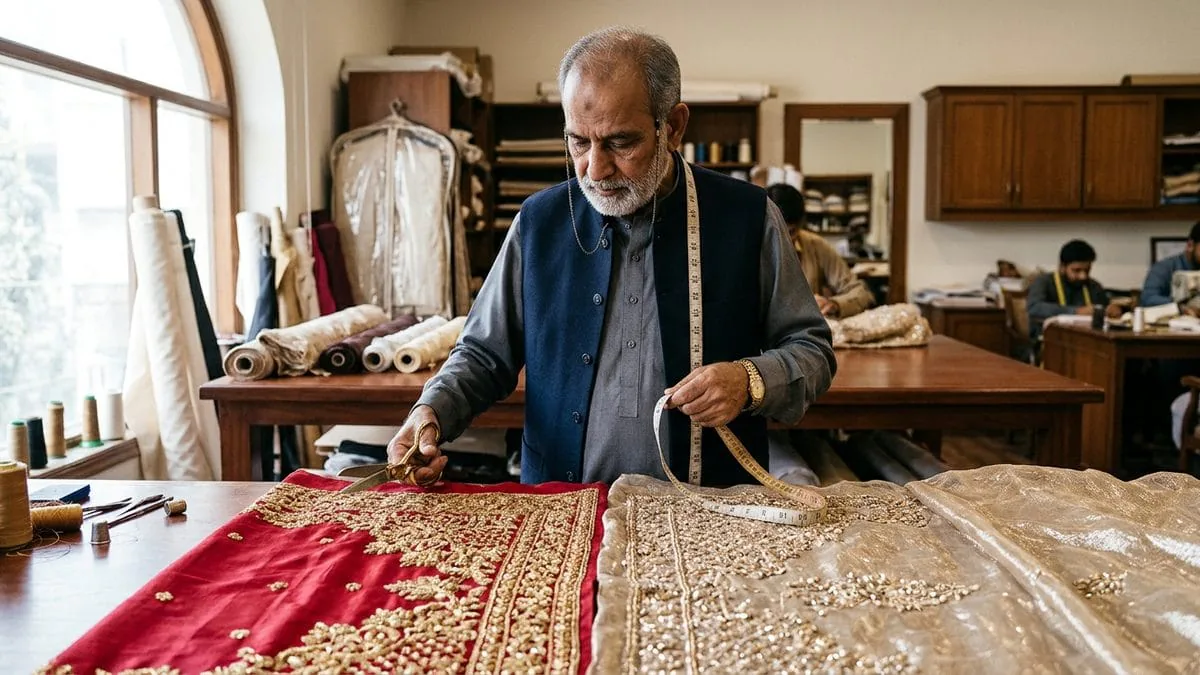
Photorealistic editorial fashion photography, 35mm lens, f/2.8 shallow depth of field, natural indirect studio sunlight, tactile fabric texture showing raised metallic threadwork grain and visible mulberry silk weave. Master Tailor Abdul Ghaffar with a graying beard, dressed in an understated charcoal waistcoat and navy kurta, holding solid brass tailor shears over an antique mahogany cutting table inside the sunlit SARTOR atelier at Model Town, Lahore. On the table lie two contrasting haute couture bridal fabric panels: rich royal crimson pure 110 GSM Katan silk lavishly adorned with sculptural gold bullion zardozi and dabka coiled wires on the left, and ethereal shimmering molten-gold French metallic tissue organza with delicate pearl and tilla threadwork on the right. Natural indirect window light raking across the textile surfaces highlights microscopic weave fibers, metallic wire facets, and subtle dust motes in the air. Shot on Hasselblad H6D-100c, 8k resolution, authentic skin pores, fine flyaway beard hairs, true-to-life studio depth, zero AI plastic smoothing, no CGI rendering, no text overlays --ar 16:9
Related Masterclasses & Guides
Bridal Masterclass
Engineering the Pakistani bridal two-dupatta system: crown anchor physics, 4kg velvet trail load distribution, and headache-free pinning for overseas brides.
Read Masterclass
→
Bridal Masterclass
Discover how SARTOR engineers hidden French bustle loops and concealed wrist ribbons into heavy 2-meter Farshi bridal trails for effortless ballroom mobility.
Read Masterclass
→
Bridal Masterclass
Learn how SARTOR engineers lightweight head veils and opulent shoulder dupattas with internal comb anchors so overseas brides in the UK, USA, and UAE stay pain-free for 12 hours.
Read Masterclass
→